
By: Baibhav Mishra*
INTRODUCTION
Cultural assimilation constitutes the transformative process by which minority groups or cultures converge with the predominant societal majority, adopting values, behaviours, and beliefs either in totality or in part. In the course of cultural assimilation, minority factions conform to the customary practices of the dominant culture, encompassing linguistic and sartorial elements. This entails relinquishing or concealing facets of their culture, spanning culinary traditions, attire, language, and religious observances. When adopted as a political doctrine, assimilationism denotes governmental strategies expressly designed to assimilate ethnic cohorts into the prevailing national culture.
This exposition posits that the governmental initiative to institute residential schools for Tribal Education parallels the historical precedent set by analogous institutions in North America and Australia, which were established with the explicit aim of ‘civilising’ and ‘de-tribalizing’ indigenous populations. A chronological examination of the history of residential schools is followed by an analysis of how these institutions serve as agents of Cultural Assimilation, elucidating the governmental role in this process.
HISTORY OF RESIDENTIAL SCHOOLS
The colonialist agenda in India, akin to its global counterparts, was directed towards the civilisational transformation of tribal communities. However, the implementation of this objective was delegated to missionaries, who were encouraged to engage with tribes and received financial backing through grants. Motivated by the aim of converting tribes to Christian beliefs, missionaries identified education as a pivotal instrument for realising this goal. The residential school system, commonly denoted as boarding schools in the Indian context, emerged as a cost-effective and efficient strategy for this purpose.
The endeavour to civilise tribal communities, spearheaded by Christian missionaries, found resonance among nationalists, particularly those influenced by Gandhi. The nationalist perspective on tribes paralleled that of the missionaries, characterising them as primitive and uncivilised, often employing the term “junglee” for depiction. The strategy used for this civilising mission involved establishing boarding schools tailored to align with Indian ethos, values, and societal norms. In the 1920s, A.V. Thakkar established Ashram schools for tribal communities in Gujarat, drawing inspiration from Gandhi’s ashrams and principles of primary education.
Post-independence, a deliberate departure from the assimilationist policy occurred, with Indian anthropologists advocating for a middle ground of ‘integration.’ Ashram schools emerged as proponents of this integration policy, gaining prominence through endorsements by commissions and committees in the 1950s. These schools became pivotal in the educational landscape, facilitated by the central government, aided by state government tribal/education departments or voluntary organisations receiving grants-in-aid.
During the 1960s, there was a notable proliferation of residential schools for Adivasi children, specifically geared towards training them for employment in industrial projects. This trend sought to cultivate a compliant workforce for industries expanding in Adivasi areas, intensifying in the 1990s with the establishment of new tribal residential schools, including state-run Kasturba Gandhi Balika Vidyalaya (KGBV), Eklavya Model Residential Schools, and private institutions like the Kalinga Institute of Social Sciences (KISS) in Bhubaneswar.
Commencing in 2005, amidst escalating Maoist conflict and heightened competition among mining companies for forest lands, numerous day schools in Adivasi villages were closed. In their stead, residential schools were instituted in south Chhattisgarh, leading to the mass relocation of Adivasi children from ‘Maoist-affected’ villages. Concurrently, corporate entities initiated funding for tribal schools, with the National Mineral Development Corporation establishing ‘education cities’ in Chhattisgarh, Adani collaborating with KISS, and Vedanta and Nalco entering agreements with KISS, financing admissions from the very tribal lands sought after by mining companies for their projects.
DELETERIOUS IMPLICATIONS OF ASSIMILATIONIST EDUCATION POLICIES
Linguistic Genocide
The first problems started with the ashram schools themselves. This is evident through an inherent contradiction in the pedagogical approach advocated by Thakkar. While being an advocate for the inclusion of tribal languages in primary education with regional language instruction for older tribal children, Thakkar’s stance faced scrutiny during an exchange in the Constituent Assembly on September 5, 1949, when Jaipal Singh Munda questioned Thakkar’s familiarity with tribal languages. This exchange brought to light the incongruity within Thakkar’s ashram schools. Despite his 1941 assertion that primary schoolteachers should possess proficiency in tribal languages, these languages were not commonly integrated into the curriculum.
This inconsistency highlights the persistent challenge in implementing the recommendation for mother-tongue instruction in tribal schools. The prevalent practice of appointing non-tribal teachers who lack linguistic proficiency in the language of the communities they serve remains a formidable obstacle. The 1990 report from the Ramamurti Committee disclosed that less than ten per cent of teachers in tribal schools belonged to Scheduled Tribe (ST) communities. Despite some improvements in specific schools, enduring biases and lower qualifications among STs perpetuate a majority of non-tribal educators.
Even initiatives like the District Primary Education Programme, endorsed by the World Bank across India since the 1990s, encounter impediments. Recruitment efforts notwithstanding, educators often contend with insufficient training, inadequate remuneration, job insecurity, and occupy subordinate positions in the school staff hierarchy. This disjunction between policy intentions and on-the-ground realities contributes to the gradual erosion of tribal languages.
Prominent linguist Ganesh Devy, known for his extensive Peoples’ Linguistic Survey of India, accentuated the rich traditions embedded in Adivasi languages, some with histories spanning millennia. For instance, the Kondhs in Odisha have preserved their language for over 3,000 years. Devy underscored the unique capacity of these languages to comprehend ecological surroundings and preserve historical memories through metaphors and myths. According to Devy, the potential loss of these languages would result in the fragmentation of communities.
While language loss is conventionally associated with individuals adopting another language, its impact is particularly profound in Adivasi culture, where cultural exchanges predominantly transpire through oral traditions such as dance, song, speech, and conversation. The exclusion of tribal languages from schools emerges as a pivotal factor contributing to their decline, leading to suboptimal learning outcomes, retention challenges, and diminished self-esteem in educational settings.
Article 350A of India’s Constitution, which enshrines the right of every child to receive education in their mother tongue, aligns with the principles of Gandhi’s Basic Education and is endorsed by experts in learning and indigenous cultures. However, tribal schools have often marginalised tribal languages, reminiscent of the assimilationist approach observed in ‘stolen generation’ schools in North America. This predicament has resulted in what experts characterise as a linguistic genocide.
Hinduisation
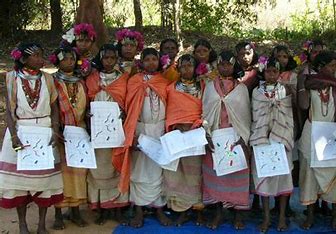
Parallel to the historical practices observed in Native American boarding schools, where children were assigned Christian names, a comparable phenomenon transpires in ashram schools, where tens of thousands of Adivasi children undergo a cultural erasure through the imposition of Hindu names upon enrollment. Beyond the realm of nomenclature, the boarding school experience for tribal children bears striking resemblance to the regimented and closely monitored lifestyle enforced upon the ‘stolen generation’ during the latter part of the nineteenth century in Canada.
Within these ashram schools, extensive control is exerted over every facet of life, reminiscent of the assimilation endeavours directed at Native American children. Notably, the cutting of hair, even for girls, is justified under the guise of lice control, Western-style uniforms supplant traditional tribal clothing, and the wearing of tribal ornaments is proscribed. This intentional erosion of traditional identity initiates promptly upon a child’s enrollment.
Boarding schools institute a substantial disconnect between tribal children and their families and communities, echoing historical strategies aimed at isolating American Indian children for the purpose of assimilation. Educational authorities sought to sever connections with native languages, cultures, and religions, emphasising complete removal from familial influences.
The latest tribal policy report, under the guidance of Virginius Xaxa, illuminates a discernible assimilationist agenda within ashram schools, characterised by a heavily Sanskritized curriculum and a conspicuous absence of Adivasi input in their administration. The report underscores an ‘ashramization of tribal education’ as an implicit facet of an undisclosed policy of assimilation. Illustratively, the Mata Rukmini Devi tribal residential school in Chhattisgarh epitomises this trend through its early morning Sanskrit classes and consistent Sanskritic prayers throughout the day.
The residential schooling paradigm compounds the predicament by physically relocating numerous children from tribal communities. This separation distances them from traditional skills, languages, knowledge, and value systems, substituting these integral aspects with aspirations oriented towards mainstream employment and identities. The coerced adoption of Hinduism and the ensuing decline of tribal culture and identity are commonly denoted as Hinduisation. The cumulative impact of these processes contributes to the assimilation of tribal children into mainstream culture and instils a sense of inferiority towards their indigenous cultural heritage.
THE IMPERATIVE FOR POLICY SHIFT
The governmental response to accusations of assimilation in Residential Schools often creates a false choice. Asserting that attendance at such institutions is voluntary and that alternative educational opportunities in village schools are available for those who opt against residential schooling. However, the diminishing presence of local day schools poses a challenge to the purported choice, as the School and Mass Education Department has initiated closures of schools with low enrollment in 2014. Subsequently, a Niti Aayog program since 2017 has sought to enhance education quality by consolidating low-enrollment schools into larger ones, ostensibly to pool resources, including teaching staff. Virginius Xaxa characterises this situation as a paradoxical interplay between the emphasis on residential schools leading to the decline of local day schools, creating a cycle resulting in the closure of primary and upper primary schools and the eventual depopulation of villages over generations. Xaxa contends that this depopulation may ultimately facilitate land acquisition for mining, leaving no populace to resist such endeavours.
Drawing parallels with the Canadian stolen generation schools, which have faced global criticism for cultural assimilation practices, a shared history of assimilative agendas in both contexts is apparent. In India, the residential school system materialised as a mechanism for missionaries to convert tribal communities to Christianity, mirroring the historical role of Christian missions in North America. The boarding school experience in both countries involves a deliberate erasure of cultural identities, akin to the strategies employed in North America, where Native American children underwent Christianization, disciplined lifestyles, and the suppression of native languages and cultures. The assimilationist agenda in Indian ashram schools is manifest in forced Hinduization, enforced haircutting, the prohibition of tribal ornaments, and the imposition of a Sanskritized curriculum, contributing to cultural erasure. The resultant language loss and erosion of traditional skills and knowledge parallel challenges indigenous communities face on both continents.
While North America and Oceania have undergone a public reckoning of the historical injustices associated with residential schooling since the 1980s, a comparable examination of assimilationism in India and other ‘developing countries’ is hindered by the prevailing notion that rapid development along ‘western/modern’ lines is imperative for fostering a monolithic national identity. Felix Padel, a research associate at the University of Sussex, posits that if residential schools are considered a vital feature of a forced assimilation policy, the events transpiring in India today mirror those in Canada 150 years ago.
An additional facet observed in various boarding schools is the pervasive occurrence of physical, sexual, and emotional abuse and humiliation. Notably, contemporary industrial-scale schools for tribal children in India, often supported by industry funding, exhibit a pronounced emphasis on preparing school-leavers for roles in industrial projects, surpassing the focus of nineteenth-century industrial schools. This underscores the contention that the government has adopted an assimilationist policy for tribals through the promotion of residential schools.
In summary, the evidence presented underscores the imperative for a policy shift away from assimilationist paradigms towards inclusive and culturally sensitive educational models that safeguard the diversity and cultural richness of tribal communities in India. The potential enduring repercussions, encompassing cultural erosion and the loss of tribal languages, underscore the need for a more deliberative and respectful approach to tribal education.
CONCLUSION
The government’s policy of establishing residential schools for Tribal Education in India mirrors a historical pattern of assimilationist strategies seen in North America and Australia. Rooted in a colonialist agenda, the missionary-led initiatives aimed at ‘civilising’ tribal communities through education bear a resemblance to the tactics employed in the ‘stolen generation’ schools. The historical trajectory, from the initiatives of Christian missionaries to post-independence integration policies and the recent surge in residential schools, illustrates a consistent push towards assimilation.
The deleterious implications of this assimilationist approach are evident in the linguistic genocide perpetuated by sidelining tribal languages in education. The exclusion of these languages contributes to the erosion of cultural heritage, poor learning outcomes, and challenges in retaining tribal identities. The counter-narrative from the government emphasises choice, but the disappearance of local day schools and the emphasis on residential ones create a chicken-and-egg situation. Parallels can be drawn with the historical assimilationist policies in North America, as both regions grapple with the erasure of indigenous cultures and identities through education.
However, amidst this bleak scenario, a ray of hope emerges from a growing network of alternative schools that respect diversity and contextual sensitivities. Initiatives like Muskaan in Bhopal and Adharshila Learning Centre in Badwani district prioritise Adivasi languages, knowledge systems, and community participation. These schools provide meaningful and engaging education, fostering self-confidence and cultural pride.
In the face of mainstreaming efforts that crush Adivasi culture, it becomes imperative to challenge the notion of ‘mainstreaming’ itself. Adivasi values and ways of life offer insights crucial for understanding the interconnectedness of biodiversity and cultural diversity. As the National Education Policy of 2020 falls short in integrating Adivasi knowledge, there is a call to reverse the gaze and learn afresh from Adivasis, acknowledging the need to preserve and celebrate their rich cultural heritage.
*Baibhav Mishra is a law undergraduate at National Academy of Legal Studies and Research, Hyderabad. The author may be contacted via mail at baibhavmishra@nalsar.ac.in.


Leave a comment