
By Jisha Garg*
Introduction
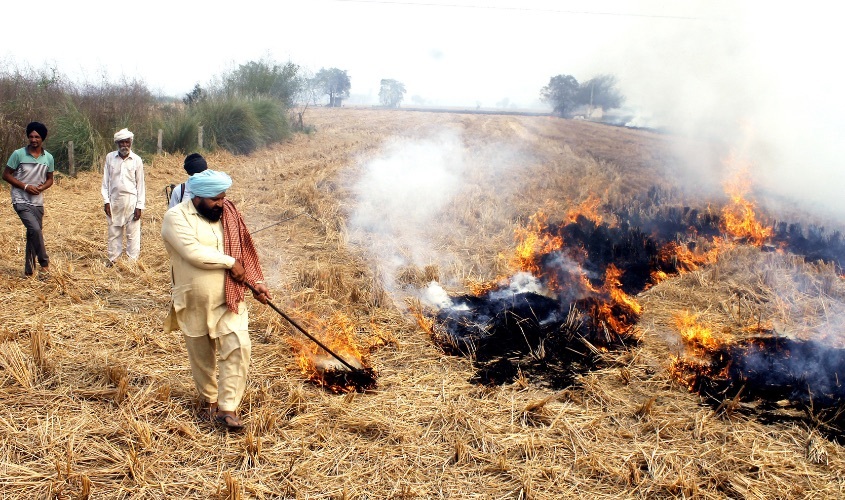
The practice of stubble burning by the farmers of Punjab, Haryana and Uttar Pradesh to get rid of the paddy residue continues to wreak havoc. Recently the Supreme Court rejected an urgent hearing of a plea seeking a complete ban on stubble burning and remarked that ‘banning’ stubble burning is not the solution and genuine ways need to be devised to tackle this problem. This is simply because even if a ban is imposed, the practice will continue unless there is an alternative that farmers can resort to. The ineffectiveness of the Government’s policy of imposition of fines to deter the farmers from stubble burning serves as an example to show that without providing alternatives to stubble burning, the menace cannot be controlled.
This piece elucidates the reasons for the failure of this policy in Punjab, nuancing on the unviability of the alternatives provided and highlighting the incongruency in the policy framework.
Failure Of Existing Policies
Data from previous years shows that the Government has been unable to collect the total amount of the fines imposed by it on farmers for stubble burning primarily due to two reasons: First, the refusal by farmers to pay fines; and second, their inability to pay them.
While the purpose of this policy is to create a deterrent effect, it is incumbent on the Government to ensure its proper implementation, which is possible only if the policy is viable. Stubble burning has not seen any significant reduction in Punjab which reflects the failure of this policy to deter the farmers from stubble burning. This is because the government has adopted it without checking the affordability, accessibility and availability of the alternatives provided. There also exists a clash between the Government’s own policies which shall be pointed out further.
1) Unviability of the alternatives provided
Apart from stubble burning, the Government has pushed for two major alternatives: (i) Use of Crop Residual Management Machines such as Super-seeders, and (ii) Use of PUSA bio-decomposer to decompose stubble.
The first alternative is not cost-efficient. Although the Government has provided 47,000 machines to the farmers at subsidized rates this year, the cost of operating these machines (including the cost of big tractors, fuel etc.) is not something an average farmer can afford. Consequently, in most of the cases, the operating cost of these machines exceeds the entire income of the farmer from that harvest.
The second alternative, i.e., the use of PUSA bio-decomposer is not time-efficient. The PUSA bio- decomposer solution is sprayed on the stubble to help it decompose. This process takes 20-25 days for the land to be prepared for the sowing of the next crop. However, the farmers do not have enough time between the harvest of paddy and sowing of the next crop (discussed further), making it unviable.
Since the existing alternatives are neither cost-efficient nor time-efficient, the farmers resort to a method which is both quick and in-expensive, i.e., stubble burning.
2) Inconsistent and Incongruent Policy Framework
Moving on to the second problem, on one hand, the Government is devising policies against stubble burning, on the other hand, there exists legislations which indirectly promote this practice. For instance, the Punjab Preservation of Subsoil Water Act, 2009 (“PPSW”), enacted to deal with the problem of diminishing water levels due to the cultivation of paddy, delays paddy harvesting, therefore, the time period available with the farmer between harvesting of paddy and planting of wheat is subsequently decreased. As a result of this, the farmers have to employ the quickest method to clear the fields for wheat plantation, which is stubble burning.
This Act imposes strict penalties in case of non-compliance with the prescribed time period, including a provision for destruction of crops. Further, it is worth noting that the Act in itself provides for burning of crops in case of non-compliance.
A 2019 report published by Nature Sustainability showed an increase in the incidents of stubble burning, especially near the wheat planting season (First week of November) after the implementation of this Act. Therefore, the Act, has incremented the instances of stubble burning.
A major incongruity which is identified is that the farmers are penalized either way, that is, (i) if they grow paddy before the prescribed time, then they are penalized under PPSW Act; and (ii) if they oblige by the PPSW Act and prepare their fields for the next crop in the limited time that they have, then they have to resort to the quickest and the most convenient way, which is stubble burning, which in turn is penalized by the Government.
In order to fight this incongruence, it is imperative for the Government to introduce changes to tackle this policy clash which makes the farmer suffer in either scenario.
Conclusion
Over the years, the Government has failed to realize that the biggest brunt of the hazardous effects of stubble burning is borne by the farmers themselves. Despite this, the farmers have continued to indulge in this practice. After analyzing the flaws in the existing policy framework, it can be concluded that only after;
[A] making the available alternatives viable in terms of cost and time efficiency; and
[B] maintaining a uniform stance via its policies, the Government will be able to seek compliance from the farmers, reduce the incidences of stubble burning and deter those who, despite having the means, would resort to stubble burning.
*Jisha Garg is a penultimate year law student at Rajiv Gandhi National University of Law, Punjab, pursuing specialization in criminal law. She has a keen interest in contemporary issues of public policy and constitutional law.



Leave a Reply