
By Dhairya Kumar*
Introduction
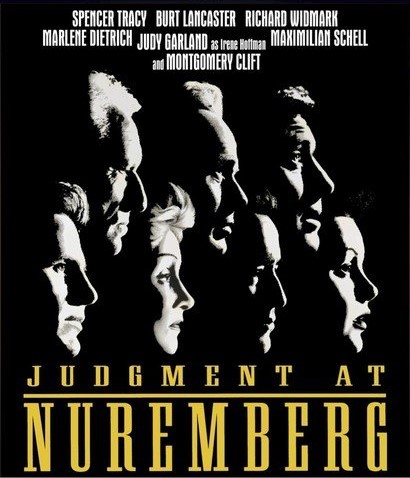
Watching the 1961 judicial drama ‘Judgment at Nuremberg’ might make one re-evaluate the legal philosophy. Following the conclusion of World War II, many in the Nazi Government were prosecuted at Nuremberg for their “crimes against humanity” during that conflict. Four German judges and prosecutors are charged for their complicity in atrocities perpetrated under the Nazi government in front of a military trial held in Nuremberg, Germany. A three-judge panel of Allied jurists who will hear and resolve the case against the accused is led by Judge Dan Haywood. If the German Judges were indeed in error, one could reasonably question. They were only performing their responsibilities, right? The judge’s responsibility is to interpret the law. However, the answer to these concerns still stays firm.
Themes
The primary emphasis in “Judgment at Nuremberg” is the Judges trial and the underlying philosophical discussion of law and morality. The emphasis on the Judges trial is incredibly fascinating since it illustrates a sense of law judging other laws. The movie has a solid political undertone due to the escalating tensions of the Cold War with the Soviet Union, the study of the principles of justice, and the predominating geopolitics. Throughout the trial, this becomes even more clear.
Directorial and Writing Style
The filmmaker executed a masterfully crafted move by using “Eugenics” as the first argument against the judges, thereby shifting the audience’s attention away from the Nazi judges’ trial and onto the trial of the law. Although the movie’s subtext suggested that German law was fundamentally corrupt and that it was up to the allied troops to uphold law and order, the Eugenics case shifts the emphasis to law and morality. This begs the question of whether Nazi Germany’s judges were at fault for mandating sterilization when their allies had done the same. Oliver Wendell Holmes, a well-known American judge, was also used in support of this thesis by quoting his decision in the Buck v Bell Case.
The world’s guilt over the rise of authoritarianism is further underscored in Hans Rolfe’s address at the film’s conclusion. One could not help but firmly concur with Rolfe, the Defense attorney, for the entirety of the film in practically all of his points, with the possible exception of the claim that while the acts were horrifying, they were not immoral. All of the defendant judges, except for Ernst Janning, maintained this belief throughout their closing arguments.
Arguments Raised Against German Judges
The major argument substantiating the guilt of the judges is that they had attained maturity long before Hitler’s rise to power, their minds were not warped at an early age by Nazi Teachings, and they embraced the ideology of the Third Reich as educated adults. In the movie, the counsel for the prosecution also contends that as guardians of law the German judges had the power to stop the brutality and atrocities committed by the Third Reich. However, they did not.
Critical Analysis
‘I believe in the idea that says to subordinate one’s feeling of justice to the authoritative legal system, to inquire simply what the law is, and to not ask whether or not it is also justice,’ Judge Hofstadter said in a statement. It is true, and that is exactly what we follow in the present-day judiciary. The question is of the violation of the law and not of justice. The Third Reich’s actions were unethical, which is implied throughout the film. The concepts of justice and fairness were violated. However, positivism’s basic tenet would endure. The goal of legal positivism is to define the law in terms of what it is, not what it should be. While it cannot be argued that laws cannot be immoral, immorality does not render laws invalid. In the film, Ernst Janning ultimately breaks down under Irene Hoffman’s cross-examination and confesses that he feels sorry for having covered up the Third Reich’s horrors out of love for his country. In his opinion, it was acceptable to restrict some people’s rights to advance the majority’s interests and enable Germany to flourish, which it did.
The film also depicts post-World War II German society as it recovers and reinvents itself via the trial’s processes. Understanding the Germans and why they supported the Nazi dictatorship was one of the movie’s central topics. It is noteworthy to note that the majority of German society does not consider public officials to be responsible for the crimes committed during the Holocaust. They were only performing their duties. The question of whether the authorities can actually be found responsible for maintaining the law in the past is now raised by this. Given that the trial focuses on these officials’ culpability, this is another grey area.
Conclusion
In the movie, Judge Haywood balances the need for geopolitical expediency with the pursuit of justice. The jury found all four defendants guilty and they were given life sentences. The final judgement by Justice Haywood at the end is still highly pertinent today as we observe a global trend toward the persecution of minorities for the advantage of the majority, as can be shown in the context of our country during various riots. Additionally, the movie also raises specific questions related to law and morality. The German judges’ judgments were based on their interpretation of the laws enacted by the ‘Third Reich’. The question, ‘if they perpetrated injustice’ by helping the Nazi government, can be questioned as they were doing their duties in reality. So, what is legally valid may not necessarily be morally or ethically correct. In the case of India, the line of reasoning adopted by judges to interpret statutes involves various doctrines, such as constructing them harmoniously and following constitutional norms and procedures. Courts have also started emphasizing on the application of the judicial mind while reviewing laws and policies. This helps prevent any patently unfair laws from getting enforced and, thus, ensures the greater good of society.
*Dhairya Kumar is a first year law student at Dr. Ram Manohar Lohiya National Law University, Lucknow.

 Kautilya Society, RMLNLU
Leave a comment